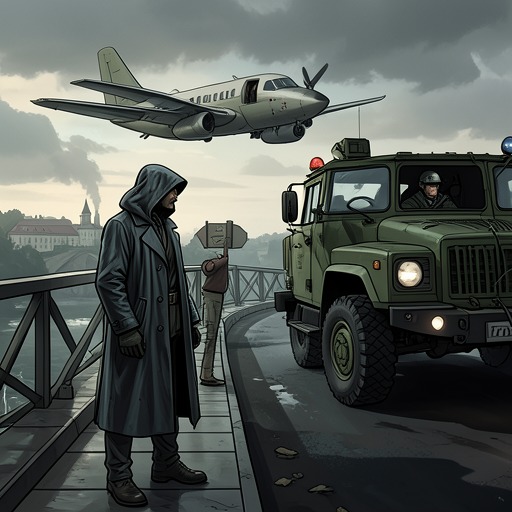
Mentz’s control-first operational policy
Heart of the HunterJanina Mentz’s control-first operational policy is an intelligence-led method of containing a fugitive before direct confrontation: establish what is known, restrict premature action, and shape the conditions under which the next move will occur. Its decisive test comes when Thobela Mpayipheli escapes the airport operation. Mentz’s response shows both the method’s practical rigor and its vulnerability: control can organize a pursuit, but it cannot substitute for knowledge of the person being pursued.
A controlled test
The policy first takes shape under The Director’s supervision. He tells Mentz to hang back and let events unfold, rather than immediately committing her team. The destination of the data is known, he reasons, making the situation a safe, controllable environment. With the expected team arrival approximately 140 minutes away, the operation also has a defined time horizon. The Director then places Mentz in charge, asks to be kept informed, and leaves the decisions in her hands. She understands that she is being tested alongside her team, Mazibuko, and the Reaction Unit; the operation is at once an attempt to manage a threat and an assessment of her command.
Mentz’s first major decision is not simply to seize the disk at the earliest opportunity. When Monica Kleintjes is confirmed to be at home, Mentz weighs taking the data and sending a team to Lusaka against the risks of involving the Reaction Unit in Zambia. Diplomatic favors and exposure make that route difficult. The Director may have to test his reaction unit another time, and Mentz’s preferred principle is to keep the matter within the family and under control. Her reasoning makes jurisdiction, visibility, and the reliability of the available force part of the operational calculation, not afterthoughts.
That calculation produces a deliberately restrained airport order. Quinn reports that the team is experienced, and Mentz directs it to bring Mpayipheli in with his bag, discreetly and quickly, without a confrontation. The intended outcome is controlled custody, not a public clash. But Mpayipheli gets away. The escape turns a managed interception into an uncertain pursuit and exposes how much the plan had depended on assumptions about his movements and the team’s ability to act without losing control.
From lost control to a mapped pursuit
After the airport failure, Mentz switches off the speakerphone angrily and identifies the breakdown in operational terms: lack of information, intelligence, and judgment, at the airport as well as elsewhere. The team no longer knows where Mpayipheli is, even if it believes it knows where he is headed and the quickest way to get there. Mentz responds by demanding a full account of who he is, why Monica went to him, where he is, and where the disk is. The policy’s first corrective measure is therefore investigative: recover the information that the initial operation did not have before making further decisions.
Mentz’s maxim is to see reality as it is rather than as she would like it to be. In the Ops Room, she stands at the end of the table, considers the developments, and remains conscious that The Director will hear the team’s words and judge her tone, decisions, and body language. Her composure is not merely personal restraint; command itself is on display. She shifts attention from the still-unanswered question of Mpayipheli’s motive to what can be acted upon: his likely route north on the N1 and the measures needed to intercept or contain him.
She has a large map put on the wall and marks the likely route in red ink. The Reaction Unit is to serve as a net, positioned seventy-seven kilometres north of Beaufort West, where the road divides and the possible routes toward Johannesburg diverge: left toward Kimberley, or right toward Bloemfontein. This plan converts a broad pursuit into a set of geographic decision points. Rather than treating the fugitive’s destination as certain in every detail, Mentz places resources where the alternatives multiply and can be monitored.
The instructions to police stations and traffic authorities along the route set a careful limit on what local officials may do. Quinn’s and Radebe’s teams are to alert them to gather intelligence, not to act. Mpayipheli is armed and can shoot, but remains largely unknown; an uninformed attempt to stop him could turn uncertainty into a confrontation. Mentz also orders investigative teams to look into Miriam Nzululwazi and Monica, then to trace Mpayipheli’s parents and friends. Information about his family and relationships is sought as operational intelligence, because the route alone does not explain his choices or predict what he may do next.
Timing, force, and contact
The same control-first logic governs the helicopters. When Quinn reports that the Rooivalk AH-2A helicopters are waiting in Beaufort West, Mentz does not send them immediately after the fugitive. She orders their crews to rest; if there is still no word by dawn, they may begin patrolling the N1 southward, but only after speaking with her team before takeoff. She does not want contact with Mpayipheli before the operation is ready. The instruction makes timing and coordination safeguards against an encounter for which the authorities are not prepared.
This caution reflects a broader distinction within her method: gathering information and positioning resources are permissible before the threat is understood, but forceful contact must wait for a more controlled moment. The policy is not a promise that violence can be avoided, nor proof that the operation is already secure. It is an effort to keep the pursuit from producing an uncontrolled encounter while the team still lacks a reliable picture of its target. The fact that the helicopters are available does not, by itself, make their immediate deployment the best choice.
Public information and the limits of control
The pursuit also becomes vulnerable to information outside Mentz’s chain of command. An unknown government intelligence agency alerts local police and traffic authorities along the N1 to watch for a Xhosa man on a large BMW motorcycle, describing him as armed and dangerous. The alert helps establish a public account of the fugitive even as the intelligence service withholds its identity. In the Cape Times, Allison Healy recasts the formal notice as the story of a big, bad biker and asks who Mpayipheli is, why the authorities want him, and why he is riding such a conspicuous machine. A pursuit designed around controlled disclosure acquires a newspaper narrative of its own.
Healy subsequently challenges the official implication that Mpayipheli stole the BMW. The dealership owner says Mpayipheli left a note explaining that he had to borrow it and would pay for its use; there has been no police charge or theft investigation. She also points out that the government has not publicly corrected the account, even though the Cape Times story has been available for hours. These details show how an operational label can become a liability when the facts behind it are not made clear. The authorities’ attempt to define the fugitive does not ensure that the public will accept that definition.
The government considers two broad responses to the press: ignore it and refuse to be intimidated, or use it to its advantage. That choice marks a limit to Mentz’s control-first approach. Her maps, instructions, and intelligence requests can organize state action, but the pursuit’s public meaning is shaped by a reporter who stands partly outside the groups she observes and sees what others miss. The episode does not show Mentz controlling that account; instead, it places operational control beside the competing work of framing and disclosure.
Method and vulnerability
Mentz’s policy is therefore more than a preference for caution. It is a sequence: test what is known, delay action when the conditions are not controlled, map likely alternatives, restrict local intervention, coordinate force, and investigate the people and relationships that might explain the fugitive’s conduct. Its strongest expression is the move from the failed airport capture to the red-marked route and the carefully bounded role assigned to the Reaction Unit and local authorities.
Its weakness is equally concrete. The initial plan treats a known destination as a safe test environment, but the airport escape leaves Mentz without the essential fact of Mpayipheli’s location. She has a likely route, a network of officials, and resources waiting near Beaufort West; she does not yet know the man well enough to make those assets equivalent to control. The policy responds to that gap by seeking more intelligence and delaying contact, but the gap itself has already changed the operation. Control remains Mentz’s objective; the pursuit demonstrates that it must continually be rebuilt from information that may arrive late, prove incomplete, or be contested in public.